
Park on the ridge road above Troodos Square around nine on a clear August night, cut the headlights, and give your eyes ten minutes to adjust. What appears overhead is something most visitors from northern Europe or the Gulf have never actually seen with their own eyes: the Milky Way as a solid, textured band of light, not a faint smudge you have to squint for. Cyprus is one of the easiest places in Europe to get a proper dark sky, and almost nobody plans a trip around it.
That is a shame, because the ingredients are all here. Low humidity, over 300 sunny days a year, a mountain range that clears 1,900 metres, and long stretches of protected coastline with no development for kilometres in any direction. This guide covers where to go, what time of year rewards the effort, and the small things that make the difference between a good night and a wasted one.
Why Cyprus Skies Work So Well
Light pollution is really a population-density problem, and inland Cyprus has very little population to speak of. Once you clear the coastal towns, villages thin out fast and street lighting with them. Combine that with air that is usually dry and free of the haze you get in more humid climates, and you have conditions that astro-tourists elsewhere pay serious money to chase.
Altitude helps too. The Troodos Observatory, perched high in the Troodos Mountains, sits well above the thin layer of dust and haze that can sit over the lowlands on a still day. On a good night up there, you are looking through noticeably less atmosphere than you would be on the coast, and it shows.
The Best Spots
Troodos Mountains
This is the obvious starting point, and it earns the reputation. The area around the Spaceship Troodos Observatory was built for exactly this purpose, with public viewing evenings that let you look through a proper telescope rather than just craning your neck. Even without joining an organised session, pulling off the main road anywhere above 1,500 metres on a moonless night gets you skies that rate close to the darkest end of the Bortle scale. Bring a jumper regardless of the season; it is genuinely cold up there after dark, even in July.
Cedar Valley
Tucked into the Paphos forest, Cedar Valley has no settlements for miles and a tree canopy that blocks stray light from any direction it might come from. The access road is rough gravel and genuinely unlit, so this is not a spot to attempt after dark unless you have driven it in daylight first. Go earlier in the evening, park up before the light fully goes, and you will have the place to yourself.
Akamas Peninsula
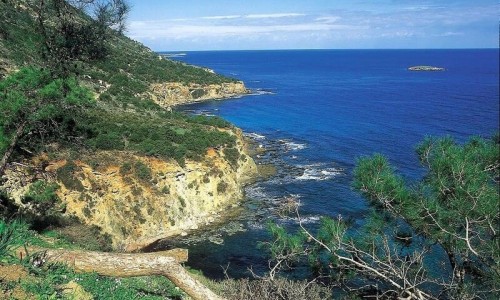
The Akamas Peninsula combines a dark inland sky with an open sea horizon, which is a rarer thing than it sounds. Most of Cyprus's darkest spots are landlocked by mountains; here you get the Milky Way rising directly out of the Mediterranean, with nothing but water between you and the stars. The unpaved tracks deeper into the peninsula are best avoided at night in a hire car, but the beaches near Lara and the headland tracks close to Latchi work well and are reachable without four-wheel drive.
Cape Greco
The odd one out on this list, because it sits within reach of Ayia Napa's considerable glow. Even so, the sea-facing side of the Cape Greco headland, with your back to the resort lights, gives a surprisingly respectable view, and it is by far the most convenient option if you are staying in the east and do not fancy a mountain drive. Do not expect Troodos-level darkness, but Orion, the winter Milky Way core, and a decent scattering of deep-sky objects are all visible on a clear night.
When to Go
Moon phase matters more than most people expect. A full moon washes out everything but the brightest stars and planets, so plan around the new moon if you can, and check a lunar calendar before booking anything. Cloud cover is rarely the problem it would be further north, but it is not zero, particularly in the wetter months.
| Period | Conditions | Notable |
|---|---|---|
| June–August | Warmest nights, driest air, most reliable clear skies | Perseid meteor shower peaks mid-August |
| September–October | Still warm, fewer crowds at Troodos viewpoints | Good all-round stretch |
| November–February | Coldest, occasional cloud and rain, but often the darkest, crispest skies of the year | Geminids peak mid-December; snow possible above 1,400m |
| March–May | Mild, greener landscape, moderate cloud risk | Good for combining with wildflower season |
August gets the most attention because of the Perseids, and rightly so, but a clear night in November or December at Troodos can be the best of the year, precisely because so few other people bother to go up the mountain once the summer crowds have gone home.
What to Bring
- Warm layers, even in summer — mountain nights drop fast once the sun is down, and there is usually a breeze
- A torch with a red-light setting, or red cellophane over a normal one, so you do not wreck everyone's night vision every time someone needs to find a snack
- A basic stargazing app for identifying constellations and satellites, downloaded in advance since signal is patchy in the mountains and non-existent in parts of Cedar Valley
- A flask of something hot — the kafenio at Troodos Square closes early, and there is nothing else up there once it does
- A paper map or offline route saved beforehand; do not rely on live navigation on unlit forest tracks
A Few Honest Caveats
You will need a car. Public transport does not run to mountain viewpoints or forest tracks after dark, and anyone relying on the routes covered in our guide to getting around without a car should treat stargazing trips as the exception where hiring one for a night makes sense. Driving unlit rural roads after dark also demands more care than the same roads in daylight; wildlife crosses without warning, and verges can be soft gravel rather than tarmac.
Skip the temptation to use your phone screen at full brightness once you arrive. It takes twenty minutes for eyes to fully adapt to darkness, and one bright screen resets that clock for everyone nearby. Dim it, or better, leave it in the car.
None of this requires expensive kit or a guided tour, though the observatory evenings are worth doing once for the telescope access alone. Mostly it requires picking a clear, moonless night, driving somewhere properly dark, and being patient while your eyes catch up with what has been up there all along.