
Just after nine on a warm July evening, a Fisheries Department warden walks the sand at Lara Bay with a red-filtered torch, checking a line of stakes pushed into the beach two months earlier. Each stake marks a nest. By the end of the season there will be well over a hundred along this single stretch of coast, laid by loggerhead and green turtles that have been coming back to the same few kilometres of Akamas shoreline since long before anyone was counting them.
Cyprus is one of the most important nesting grounds for marine turtles in the Mediterranean, and the season runs right through the summer months when most visitors are already on the island. Yet plenty of people spend a week in Paphos without ever hearing about it. This is what you need to know if you want to see it properly, and without doing the turtles any harm.
Two species, one stretch of sand

Two species nest on Cyprus beaches: the loggerhead (Caretta caretta) and the green turtle (Chelonia mydas). Loggerheads are the more common nester in the south, with a reddish-brown shell and a noticeably large head built for crushing shellfish. Greens are bigger, smoother-shelled, and named for the colour of their body fat rather than their skin, which is closer to olive-brown.
Both are listed as endangered, and both have used Cyprus's beaches for so long that the island's nesting figures are tracked as a benchmark for the wider eastern Mediterranean population. A female turtle will typically nest two or three times in a season, at roughly two-week intervals, then vanish back out to sea and not return to breed again for two or three years.
When to go
Nesting runs from June to early August, with the peak in late June and July. Incubation takes around fifty to sixty days, so hatchlings start breaking the surface from mid-August, and the emergences continue into October. If you want to see a female coming ashore to lay, you need a warm, calm night in July. If you want hatchlings scrambling for the water, aim for a dawn or dusk visit in late August or September, when temperatures are gentler and gulls are less likely to be waiting.
| Species | Nesting window | Typical hatching |
|---|---|---|
| Loggerhead (Caretta caretta) | June - early August | August - October |
| Green (Chelonia mydas) | June - August | August - October |
Lara Bay and Toxeftra
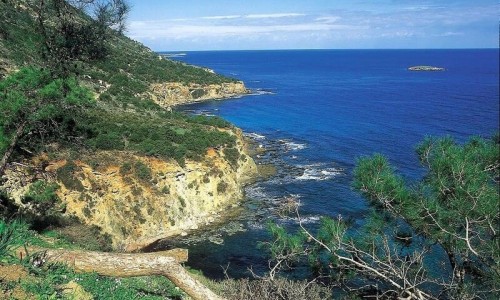
The main nesting beaches in the government-controlled area sit inside the Akamas Peninsula, north of Paphos: Lara Beach itself and, a little further south, Toxeftra. A joint monitoring project between the Fisheries Department and the University of Exeter's marine turtle research group has patrolled these sands every summer since 1978, one of the longest-running turtle conservation programmes anywhere in the world. Wardens mark and protect nests from foxes, ghost crabs and the tide, and relocate eggs laid too close to the waterline.
Getting there takes a bit of effort, which is part of why the beach has stayed as undisturbed as it has. The unpaved track in from Agios Georgios is manageable in an ordinary car if it hasn't rained, though a 4x4 makes it easier. There's no village at Lara itself, just a small seasonal snack bar, so bring water and sun cream and don't expect facilities beyond the basics.
The other turtle beaches

Lara and Toxeftra take the bulk of the nesting, but they are not the only beaches on the island where turtles come ashore. White River Beach, further along the same undeveloped stretch of the Paphos coast, is a nesting ground for loggerheads, which haul out after dark through the summer to lay. On the south coast, Mazotos Beach in the Larnaca district sees nesting through the summer months, and Episkopi Bay is recorded as nesting habitat as well as a stop for migratory birds.
Seeing a turtle in the water is a much easier proposition than seeing one nest, and it does not carry the same risk of disturbing anything. Green Bay at Protaras is known to almost everyone as Turtle Bay and has earned the name: shallow, sheltered and about the most reliable place on the island to meet one while snorkelling or on a first dive. Boat trips out of Latchi along the Akamas coast often call at Lara Bay, and turtles are regularly seen in the water off Blue Lagoon.
Inland at Inia, in the hills above the Akamas, a site for a dedicated turtle museum has been prepared in the village square. It is a recent project, so it is worth checking whether it has opened before making the drive up.
Watching without disturbing

Nesting turtles are easily spooked, and hatchlings navigate by the brightest light on the horizon, which for millions of years has reliably been the sea and is now, on a developed coastline, just as likely to be a hotel car park. A few rules matter more than any others:
- No white light or camera flash near a nesting female or a nest close to hatching; use a torch with a red filter if you need one at all.
- Keep well back from a turtle that's digging or laying, and never touch the eggs or the hatchlings.
- Don't dig around staked nests, and keep dogs off the beach after dark during nesting season.
- If you find hatchlings heading the wrong way, tell a warden rather than picking them up yourself.
There's no formal ticketed "turtle watch" at Lara the way there is at some beaches further north, so seeing a nesting female is partly down to luck and patience rather than a scheduled tour. Wardens on site during the season are generally happy to point curious visitors toward marked nests due to hatch, provided you keep the noise and the lights down.
North of the line
Turtles nest across the whole island, not just the Republic-controlled south. Alagadi Beach near Kyrenia is the best-known site in the north, where the Society for the Protection of Turtles runs guided evening watches through the summer, and the remote beaches of the Karpas Peninsula see some of the heaviest green turtle nesting anywhere on Cyprus. Crossing the line for a dedicated turtle trip is a bigger undertaking than a day out from Paphos, but worth knowing about if your itinerary already has you headed that way.
Making an evening of it
Lara pairs naturally with the rest of the Akamas coast. Spend the afternoon on the coastal path or in the Akamas forest, then work your way back toward Latchi for a fish meze as the light drops, before returning to Lara for last light and the chance of a nesting turtle. Polis Chrysochou, a short drive inland, is a sensible base for the night if you don't fancy the twisting road back to Paphos in the dark.
One honest caveat: you may see nothing at all. Turtles don't perform on schedule, and a warm, still night with no wind is a better bet than a scheduled evening off a coach tour. Go with low expectations and a torch you're not planning to switch on, and treat an actual sighting as the rare thing it is rather than a guaranteed photo opportunity.