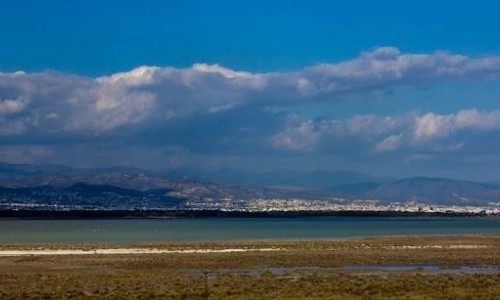


On the western edge of Limassol, minutes from busy roads and shopping centres, the Limassol Salt Lake is a wide, shallow basin that changes colour and character with the seasons. It is a seasonal lake rather than a permanent one, and that cycle is the whole point of the place.
A lake that disappears and returns
In winter, rainwater fills the basin and forms a broad mirror that reflects the sky in pale blues and silvers. Through spring the water retreats, concentrating minerals and leaving patterns across the surface. By summer much of it has dried out, leaving a white salt crust that cracks into geometric plates under the sun.
The salt is the residue of thousands of years of evaporation and mineral deposition. Walking the same path in different months genuinely feels like visiting different places: a winter wetland, a spring bird sanctuary, a summer salt flat.
The birds
The lake works as a resting and feeding ground on migration routes between Africa and Europe. Flamingos are the best-known visitors, and seeing them feed with their heads submerged this close to a city is the image most people come away with. They are not the only ones — herons, stilts, avocets and ducks all use the lake as a stopover.
That traffic is also what makes the site ecologically sensitive: it depends on water levels, and it responds to human activity and to changes in climate. There is more on the island's migration routes in our guide to birdwatching in Cyprus, and Cyprus has a second, larger salt lake system at Larnaca.
Salt, history and the land around it
Salt was a valuable resource for centuries, and lakes like this one carried real economic weight. The flat, mineral-rich ground around the basin is a reminder that people depended on this landscape for a living long before anyone came to look at the birds. The wider area sits on the Akrotiri Peninsula, the southernmost point of the island.
Quiet, in the middle of a city
What is most striking is how quickly the noise drops. Step onto the walking paths and the highways behind you stop registering; the open horizon and the slow movement of water and birds do the rest. Sunrise turns the surface gold and pink, sunset turns it copper, and even under cloud the muted tones hold up. It is a good place to walk and an unusually good one to photograph.
Every visit is different
Wind textures the water, heat blurs the horizon, and rain turns dry ground into shallow pools that attract life within hours. In winter it feels full and alive; in high summer it is stark and almost lunar. That variability is the reason to go back rather than a reason to time it perfectly.
Nearby
The western side of Limassol packs a lot into a short drive. Kolossi Castle and the Kourion archaeological site are both close, Kourion Beach sits below the site, and the rest of the coast is under beaches in Limassol.
Near Limassol Salt Lake
Other places within a short drive, closest first.