
Most of the culture of Cyprus is bound up with Greek culture, which has been present on the island since antiquity, but it has also absorbed elements from its Arab and Turkish neighbours. Since the division of the island the two communities have developed largely separately, each oriented towards Greece and Turkey respectively, with little exchange between them.
Facts and figures
- Location: an island in the eastern Mediterranean, south of Turkey
- Capital: Nicosia (Lefkosia)
- Climate: Mediterranean — hot, dry summers and cool winters
- Government: republic
- Official languages: Greek and Turkish
Population
The most recent figures from the Cyprus statistical service put the population at about 983,000 (2024), distributed across the districts as follows:
- Lefkosia (Nicosia) — 369,400
- Lemesos (Limassol) — 280,300
- Larnaka — 165,500
- Pafos — 108,900
- Ammochostos (Famagusta) — 58,900
Full breakdowns, including how these numbers have moved over time, are on our Cyprus population statistics page.
Demography
The 1960 census, taken at independence, recorded a total population of 573,566:
- Greek Cypriots — 77 per cent (441,656)
- Turkish Cypriots — 18.3 per cent (104,942)
- Armenians and Gregorians — 0.6 per cent (3,378)
- Roman Catholics and Maronites — 0.5 per cent (2,752)
The 2001 figures gave an ethnic make-up of roughly 77 per cent Greek, 18 per cent Turkish and 5 per cent other, with religious affiliation at 78 per cent Greek Orthodox, 18 per cent Muslim and 4 per cent Maronite, Armenian Apostolic and other. Since the division of the island the distribution has changed considerably, with movement of population in both directions.
Languages
Cyprus has two official languages, Greek and Turkish. The Greek spoken here is a strong dialect — roughly 15 per cent of its vocabulary is peculiar to Cyprus and not used in mainland Greek. Minority languages include Armenian, Cypriot Maronite Arabic and Romani.
English is widely spoken: about 76 per cent of the population, with roughly 12 per cent speaking French and 5 per cent German.
Literature
The best-known literary work associated with the island is the Cypria, an epic poem attributed to Stasinus, a semi-legendary poet who set out the full history of the Trojan War in epic hexameter. Epic poetry known as the acritic songs flourished through the Middle Ages. Modern poets and writers include Kostas Montis, Michalis Pasiardis and Dimitris Lipertis.
Education
Students are expected to complete 12 to 14 years of education. The system runs as follows:
- Pre-primary: one year is compulsory, taking children from the age of three.
- Primary: compulsory, six years. Also provided by English, French and Russian-language private schools.
- Secondary: two three-year cycles, Gymnasio then Lykeio, for ages 12 to 18. Students may take Secondary Technical and Vocational Education in place of the Lykeio.
- Higher: public or private universities, with campuses in Lefkosia and other towns.
Food and everyday culture
Cypriot culture is easiest to meet at the table. The meze — a long sequence of small dishes rather than a single course — is the clearest expression of it, and halloumi is the island's best-known export. The wider range of dishes is under Cypriot cuisine.
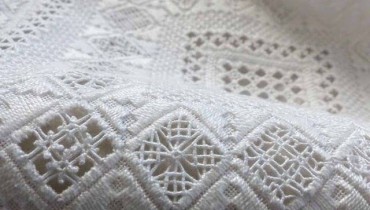
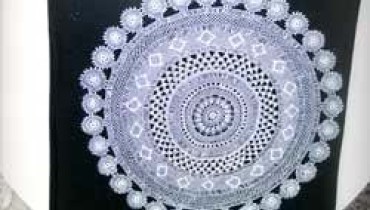
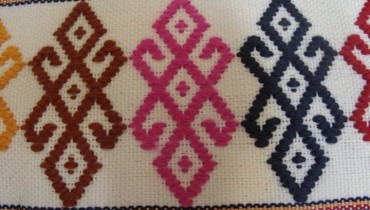
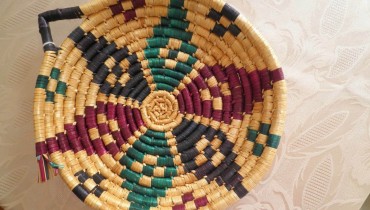
All the crafts and traditions on Cyprus Island
5 crafts and traditions documented on this site. 4 of them are plotted on Cyprus in 3D.
- Larnaca
Cyprus Embroidery
- Limassol
Pipilla of Omodos
- Paphos
Cyprus Weaving