

The EDRO III is a cargo ship that ran aground on the rocky coast of Peyia in the Paphos district and never left. During 2011 it sailed from Limassol port bound for Rhodes; it came ashore instead beside the sea caves at Peyia, where it still sits upright and largely intact a few metres off the rocks. It has since become one of the most photographed sights on the west coast.
What happened
The EDRO III was an ordinary cargo vessel doing ordinary work. It left Limassol for Rhodes, ran aground on the Paphos coast, and stopped. It did not sink and it did not break apart. It settled upright, close enough to shore that you can stand on the rocks and look straight at it.
That last detail is what separates this wreck from the others on the island. Most of the wrecks documented on this site are dive sites, reached by boat and seen underwater — the shipwrecks of Cyprus are largely a diver's subject. The EDRO III is the exception. It requires no boat, no equipment and no booking. You walk to the edge of the rocks and it is there.
Where it is and how to reach it
The wreck lies on the coast below Peyia, immediately beside the sea caves, and a short drive from Coral Bay — one of the busiest stretches of coast in Paphos. Many people arrive for the beaches and end up here afterwards, because the two sit within a few minutes of each other.
The approach is along the coastal road past the sea caves. The ground near the wreck is uneven rock rather than sand or path, so footwear matters more than it does at the beaches nearby, and the edge is exposed. The Sea Caves Nature Trail covers the same stretch of coastline on foot for anyone who would rather walk in than drive to it.
The best time to see it
In daylight the wreck is bold and plainly readable. Under the Cyprus sun every line and edge stands out — the rust, the shape of the hull, the damage left by years of exposure. The sea around it usually sparkles, which softens the harshness and sets up the contrast that most people come for: hard industrial metal against clear blue water and pale stone.
Late afternoon and sunset are the reason most photographers make the trip. As the sun drops, the sky fills with orange and gold and the ship goes dark against it. At that hour it reads less like a stranded cargo vessel and more like something deliberately placed — a monument rather than an accident. If you are making one visit, make it that one.
Every angle offers something different. Wide shots place the ship against sea and sky; close ones find rusted texture, broken lines and worn metal. Depending on the hour and the weather the same vessel can look peaceful, dramatic or faintly menacing, which is why it draws professionals and phone photographers in roughly equal numbers.
How it changes through the year
The wreck is not the same sight in every season. In summer the light is strong, the sea is usually calm and the coast is busy; the ship looks bright and almost stately against a clear sky. In winter the mood inverts. Stronger winds, rougher seas and heavier cloud make it look wild, and the waves breaking on the rocks give the impression that the sea has not finished with it yet.
This is why people come back. It is the same ship in the same place, but light, weather and sea state change the experience enough that a second visit rarely feels like a repeat of the first.
Why a wreck holds the attention
Ships are built to move. A wrecked one tells the opposite story — a journey that ended somewhere it was not meant to end. Even without knowing the details, most people looking at the EDRO III find themselves wondering about the night it came ashore and the conditions that put it there. The vessel does the work of a story without telling one.
There is also something durable about it. After years of wind, salt, waves and sun, most of the structure is still standing and still recognisable. Nature has worn it down without removing it. Damaged and abandoned, it remains imposing, and that mixture of strength and fragility is a large part of why it stays in the memory.
It has also changed meaning over time. What began as an accident and a stranded hull is now a landmark that people travel to see. It was never intended to be an attraction, and it has become one of the more recognisable images of the Paphos coastline — a reminder that this district's coast is not only organised beaches and resorts, but something rawer as well.
Nearby
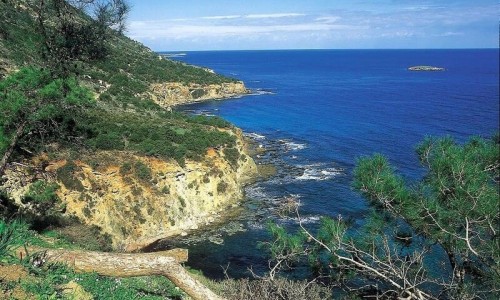
The wreck sits inside one of the best stretches of coast in the district, and few people see it on its own. The sea caves at Peyia are immediately alongside it, Coral Bay is minutes away, and the Akamas Peninsula begins further up the same coast.
For the island's other wrecks, the full list of Cyprus shipwrecks covers all of them by district; the closest comparison is the MV Dimitrios II at Chloraka, the other Paphos wreck you can see from land. Divers should start with the Cyprus diving sites instead. The whole coastline, cliffs included, is easiest to place on Cyprus in 3D.
Near Edro III Shipwreck
Other places within a short drive, closest first.