
Cyprus is not uniformly sandy, and the difference matters more than the brochures admit — a beach that is fine golden sand at one end of the island can be smooth grey pebbles an hour’s drive away, which is a poor thing to discover with small children and no water shoes. Of the 110 beaches documented on this site, 84 are described as sand with no mention of pebbles or shingle. This page is about those, and about where the sand stops.
The best known

Most of the famous names are genuinely sandy. Nissi Beach at Ayia Napa and Fig Tree Bay at Protaras are the two everyone arrives for — golden sand at the first, soft white sand at the second. Makronissos is powdery golden sand and rather calmer than either. Landa Beach is nicknamed the Golden Beach for exactly the reason you would guess, and Konnos Bay sits in a sheltered cove below Cape Greco.
Along the south coast, Finikoudes in Larnaca has soft golden sand that is raked daily, and Mackenzie next to it adds the low-flying aircraft. Lady’s Mile is the long one — an extensive sandy shoreline with almost nothing built on it — and Governor’s Beach sits between Limassol and Larnaca below cliffs, with walking trails through the hills behind it.
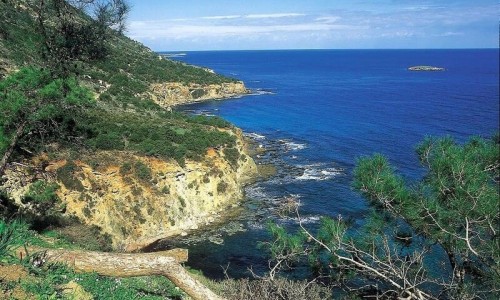
In the west, Coral Bay is deep golden sand between two headlands, and Lara Beach out on the Akamas is the wildest of them: the access road is rough enough that a 4x4 is recommended, and there is no development at the end of it.
Where they are
The sand is not spread evenly. Famagusta district has by far the most, with 34 of the sandy beaches documented here — the whole south-east corner from Ayia Napa round to Protaras is built on it. Limassol has 22, Larnaca 15 and Paphos 13. Paphos has the drama and the archaeology; if what you want is simply to walk into the sea off soft sand, the east coast is where to base yourself.
Blue Flag beaches
25 of the beaches on this site hold or have held a Blue Flag — the international award for water quality, safety, facilities and environmental management. Among them are Paphos Municipality Beach, Alykes, Miami Beach and Aphrodite Beach. A Blue Flag is a good proxy for lifeguards, cleaned sand and somewhere to buy a coffee — it is not a promise of quiet.
Where the sand runs out

Thirteen of the beaches here are a mix of sand and pebbles, and three are pebble with no sand at all. Two of those catch people out.
Petra tou Romiou — Aphrodite’s Rock, the single most photographed spot on the island — is a pebbled beach beneath cliffs. It is worth stopping for, but it is not a beach to spend a day on with a towel. Latchi, likewise, is a pebble-strewn shore rather than the sandy bay its reputation implies.
Elsewhere the mix is gentler: Agia Varvara shifts between soft golden sand, small pebbles and gravel along its length; Pomos is dark fine sand with smooth coloured pebbles; Mandria and Avdimou Bay are mostly sand with some pebbles through it.
Practical notes
The season runs long here: the sea is swimmable from roughly May into November, and the organised beaches put out sunbeds and umbrellas for hire through it. July and August are the hottest and the busiest, and the popular sand in Ayia Napa fills early. Late spring and September are the better months by some distance.
Two things worth knowing before choosing. Some of the finest sand is on beaches where turtles nest through the summer — Lara most of all — which brings restrictions on lights, umbrellas and vehicles that are there for good reason. And if step-free access matters, the site keeps a separate list of beaches with wheelchair access. For everything else, see all Cyprus beaches.