
The Panagia Chrysolofitissa Church or "Παναγία Χρυσολοφίτισσα" in Greek is located in the Lofou Village in the Limassol district.
The church was built during the 19th century. In particular from 1854 until 1872, the main building of the church was built. It is a one part church which has gothic art. Its floor is covered with small square mosaic tiles. The church is 30 metres length and 13 metres wide.
The interior of the temple is decorated with hagiographies, a temblo, a throne and the wooden iconostasis. The hagiographies were made by Othona Yiavropoulo while the temblo and the throne by Eftihio Leptourgou. It is worth mentioning that the hagiographies of the whole temple were made by Othona Yiavropoulo and it lasted from 191 until 1919.
In the church there are many old icons of the Virgin Mary, one of the 11th century which is located in the altar and one which is of the 16th century. According to the community, the icon which is of the 16th century was made by a clumsy painter who tried to redo the icon of the Virgin Mary and was punished by the Virgin Mary herself.
On the outside the church is decorated with two bell towers made of stone which were completed during the beginning of the 20th century and in particular in 1910. The first bell tower is more magnificent than the second. The first bell tower has a large bell which could be hear by the nearby villages such as Lania, Kyvides and Kilani. Today the bell is not so loud and works with electricity so its power has decreased.
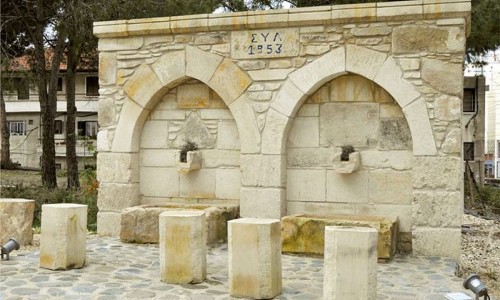
Previously the bell tower has a rich decoration with four angels and eight lions which were transferred to the entrance of the church and to the water tap of the square. This transfer occurred to solve the problem which the statues were doing to the bell tower. The other bell tower is small. In the past the bell was a school bell which was used in order to call the children to the morning and afternoon lessons.
Especially interesting is the construction of the church. According to tradition, the church is built in the place where the shepherds found the icon of the Virgin Mary. These shepherds lived in Finika an area south of Lofou and they led their flock in the position it is today. Many nights the shepherds saw a light coming from a cave which is named the cave of Hadjirossou. When they decided to go to the place where the light was coming from they searched in the thick plantation and found the icon of the Virgin Mary which they took with them. The next day the icon disappeared. It was transferred back to where they found it. So the shepherds decided to clean the area where they found the icon and build a small house. They put the icon of the Virgin Mary there and later on in the mid-19th century a church was built.
It is remarkable that all the villagers gave money in order to build the church. The only people who were paid where the technicians who were from other parts. Each villagers took one job for example brining water, bringing stones or concrete.
Near Panagia Chrysolofitissa Church- Lofou Village
Other places within a short drive, closest first.