

Fabrica Hill is located in the northeast part of the ancient town of Paphos and the hill has many archaeological remains in it, including the theatre.
The theatre of Nea Paphos is located in the north side of the Fabrica Hill. The theatre is partly carved in a natural rock of the hill and partly built. It was used for theatre shows from the period that the town was founded (around 3000 B.C) until its destruction by earthquakes in the 4th century A.D. The peak of the theatre is dated to the middle of the 2nd century A.D, during the ruling of the emperors Antonio Pious and Mark Avrilious, therefore the stage and the entrances were decorated with marble sculptures and written decoration.
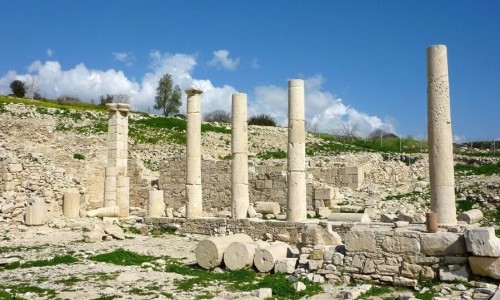
Apart from the theatre, the archaeological excavation revealed part of the ancient town that is located around the theatre. A paved road of the Roman period has been revealed at the north side of the theatre and a Nymphaeum or public fountain also of the Roman period was found to the southeast. These elements are an important addition to the knowledge of the urban surroundings of the ancient Nea Paphos.
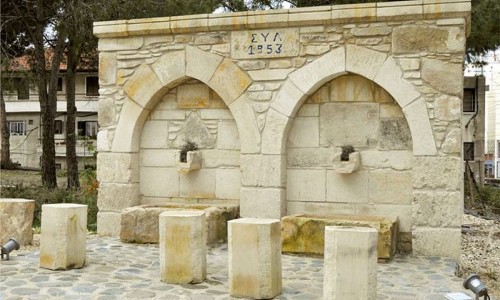
The archaeological period of the year 2017 focused on the southeast part of the area, near the Nympehou at the east edge of the theatre. Three archaeological incisions were made. Incision 17A revealed the largest part of the paved street. Also the complete front wall of the Nympehou was discovered. The Nympheon has 20 metres length, 5 metres width and its walls have a width of 1 metre. Small pits were found carved in the stone on the top of the front wall, which form a board gave antiquity and seems to have been played by workers during the construction. The Nympheon is dated to the beginning of the 2nd century A.D and is proof of the knowledge of the Romans for water management as well as their ability to configure open spaces within the town. A small water well covered with hydraulic mortar was also found in the front part of the Nympheou, which is probably where people passing by drank water from.
The second intersection was opened behind the Nympheon, in order to explore the area between the Antonineia outreach of the theatre and the Nympheon. A series of carved grooves were found, which is associated with the water management to and from the theatre and the Nympheon.
The third intersection was designed in order to reveal the exterior wall of the theatre of the Antoninon period. Carvings in the rocks prove that this wall has a width of 2.2 metres and was built by carved surfaces in order to support the beams on which the spectator seats were placed.
Near Fabrica Hill - Paphos
Other places within a short drive, closest first.