
Cyprus has caves of three quite different kinds, and people looking for one are usually not looking for the others. There are the sea caves the waves cut into the soft limestone of the coast. There are cave churches, hollows that were turned into chapels and in one case into a shrine built around a pile of bones. And there are the caves that exist mostly as stories — a dragon, a cyclops, a saint who keeps lovers together. This site documents 15 of them, and they are spread unevenly: Paphos and Famagusta hold most.
The sea caves
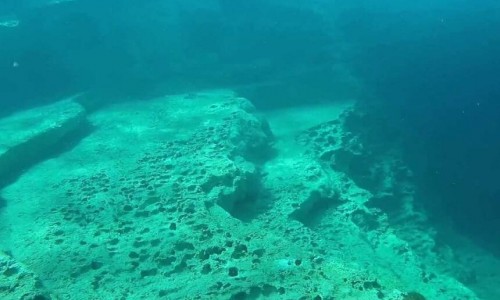
The Ayia Napa Sea Caves are the ones most people mean. Over thousands of years the waves have carved deep hollows, arches and caverns into the soft limestone cliffs, forming a network that stretches both above and below sea level. Some are large enough to walk into at low tide; others can only be reached by swimming, snorkelling or kayaking — which is the single most useful thing to know before setting out.
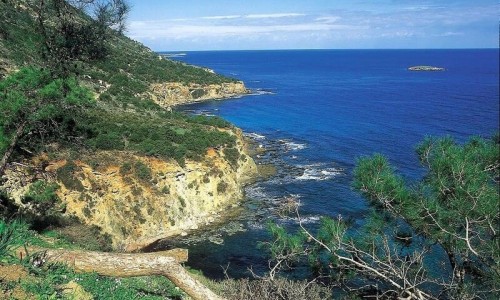
Along the same south-east coast, the Agioi Anargyroi Sea Caves sit in the Cape Greco area between Protaras and Ayia Napa, below rugged limestone cliffs. It is the quieter half of that coastline, and better for walking and photography than for swimming.
In the west, the Sea Caves at Peyia are a short drive from Paphos, where centuries of erosion have sculpted the limestone into cliffs and hidden caverns. Further north again, Dragon Cave on the Pomos coast is a series of caverns and arches cut by the sea — and local folklore says a dragon once lived in it.
The cave churches
This is the group with no equivalent anywhere else, and the best of them is Agioi Saranta at Xylofagou. It sits south-west of the village in a deserted stretch of coast, below a cliff that drops vertically into the sea. The name was not given at random: fossilised bones were found inside, taken to be the remains of Christian martyrs killed during the persecutions, and local tradition holds that the Forty Saints lived in the cave itself.
A short distance away, the Church of Panagia Evangelistria carries a related story: before pirates killed the monks, the Bible and the icon of the Virgin were carried to a nearby cave for safekeeping.
In Paphos district, Panagia Chrysospiliotissa at Pano Arodes is a temple carved directly into the rock, dating to the Byzantine and Roman periods; a few icons remain inside, where there were once murals. Agiou Lambrianou Cave at Emba is the other Paphos example.
The caves with stories
Agios Agapitikos at Kato Paphos is the one worth going out of your way for. Agios Agapitikos is the Saint of Love, the protector of lovers, and the belief attached to the cave is specific: couples who go there together and hold hands will stay together, and nothing will separate them.
Cyclops Cave sits on the south-west side of Famagusta district, one of those sites hidden well enough that most people never find it. The simplest way in is to park at Konnos Bay and take the nature trail north of the beach, up the hill. Ayios Kournoutas Cave in Paphos is quieter still.
Walking to them
Three of the marked trails on this site end at a cave, which is usually the better way to arrive. The Sea Caves Nature Trail and the Agioi Anargyroi Sea Caves Nature Trail both run along the Famagusta coast, and the Konnoi – Spylia tou Kyklopa trail follows the shore to the Cyclops Cave and back.
Before you go
Sea caves are cut by water and most of them still meet it. Check the sea state rather than the forecast: a cave that is a walk-in at low tide on a calm morning is a bad idea in a swell, and the ones reached by swimming are not the place to discover that. Wear something on your feet — wet limestone is sharp and slippery in equal measure — and take a torch for anything you intend to go inside.
The cave churches are the opposite problem: they are easy to reach and easy to miss, often unsigned and set back from the road. For the wider picture see all Cyprus attractions, and the coastal ones are easiest to place on Cyprus in 3D, where the cliffs they sit under are actually visible.