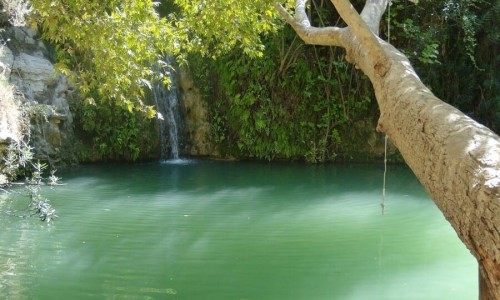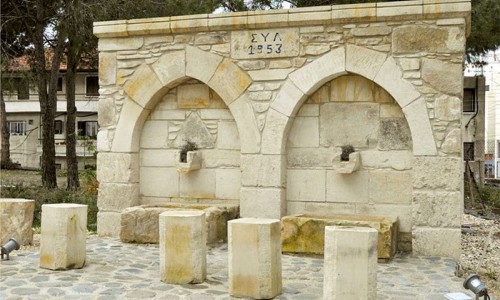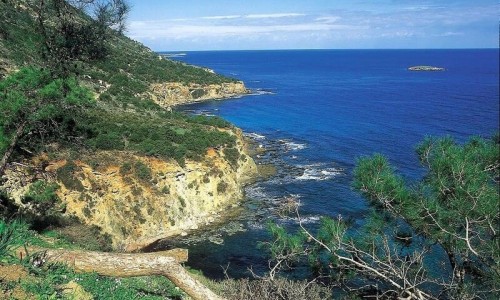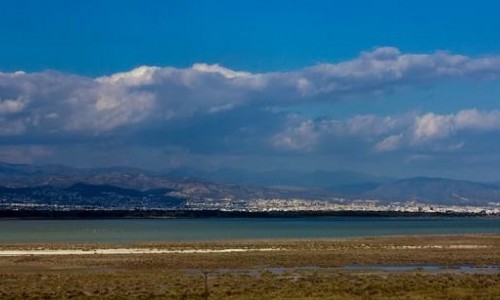

Most of what people remember about Cyprus happens above 700 metres. The mountain villages of the Troodos are where the vines, the cherries and the roses grow, where the painted churches survived four centuries of Ottoman rule because nobody came looking, and where Cypriots still go in August to escape the coast. This site documents 272 villages, of which 74 record their altitude — and those are the ones this page is about.
The highest villages
Prodromos sits at the highest altitude of any village in Cyprus: its land runs from 1,300 to 1,540 metres, averaging around 1,420. Below it, Alona and Kyperounta both stand at about 1,200 metres, and Agros and Lemithou at around 1,100. Chandria is at 1,000 metres.
Height is not a curiosity here, it is the whole character of the place. At 1,200 metres a Cypriot village is ten degrees cooler than Limassol in August, holds snow in February, and grows fruit that will not set at sea level.
The valleys

The Troodos villages fall into a few distinct groups, and knowing which is which makes the map far easier to read.
Marathasa, on the northern side of the range, holds Pedoulas, Kalopanayiotis, Milikouri, Treis Elies, Lemithou and Prodromos. It is the green side of the mountain, terraced with cherry and apple.
Solea, on the northern slopes, takes in Galata and neighbouring Kakopetria, the latter at around 667 metres and the easiest of all the mountain villages to reach from Nicosia.
Pitsilia, on the eastern flank, is the largest group and the least visited: Palaichori, Platanistasa, Agridia, Alona and Agros among them.
South-west of the peak, the Krasochoria — the wine villages — sit lower, between roughly 600 and 800 metres: Omodos, Lofou, Vasa Koilaniou and Pachna.
What each is known for

They are not interchangeable. Agros is the rose village: it grows the damask rose, Rosa damascena, whose petals are picked by hand at dawn during the annual harvest and turned into rosewater, rose oil, liqueurs and sweets. Kalopanayiotis has sulphur springs and a monastery whose wall paintings rank with the finest on the island. Lofou is the one to walk: stone-paved alleys and preserved architecture, with almost nothing modern in the frame. Omodos has the cobbled square and the monastery at the centre of the Krasochoria, and is the busiest of them for that reason.
Several of the painted churches inscribed on the UNESCO World Heritage List stand in these villages — among them Archangelos Michael at Pedoulas, Panagia tou Moutoulla, Panagia Podithou at Galata and Stavros tou Agiasmati near Platanistasa.
Visiting
The roads are surfaced and perfectly manageable, but they are mountain roads: single track in places, tight through the village centres, and slower than the distance suggests. Allow roughly twice the time a map gives you, and park at the edge of a village rather than driving into it.
Spring is the best of it, with the fruit blossom in April and the roses at Agros in May. Summer is when Cypriots come up, and the high villages are the reason: cool nights and shade at a time when the coast has neither. Autumn brings the grape harvest to the Krasochoria. In winter the highest villages get snow, and the road over the top can close, so check before setting out.
Most villages have at least one taverna and many now have restored stone houses to stay in. For the wine side of the mountain see Cyprus wine villages and the wineries; for walking, the nature trails nearly all start up here.